
Back to School Toolkit
What is the best back-to-school strategy for 2026?
The best back-to-school strategy is to create a master supply list for every student, shop in July for the deepest discounts, and use color-coded organization systems to prevent lost items. The average household spends approximately $875 on back-to-school supplies, according to Statista data. By planning two to four weeks ahead, comparing online prices, and stocking up on essentials for grades K–12, families can reduce costs by 15–30 percent while ensuring every student walks into the first day fully prepared.
This guide breaks down exactly what every student needs, grade by grade, plus practical tips for keeping costs manageable and stress off the radar. Whether you are a first-time kindergarten parent or a college student gearing up for senior year, you will find actionable checklists, product recommendations, and strategies that actually work.
How do I plan and budget for back-to-school shopping?
The single biggest mistake families make is waiting until the last week of August to buy supplies. Advanced planning saves money, prevents panic purchases, and gives students a head start on building good habits. Here is how to do it right:
- Start in July. Two to four weeks before school begins gives you time to hunt for deals, compare prices, and involve your child in the process.
- Check the school list first. Most schools publish a required-supplies list at the start of each year. Buy only what is on the list — and what is not damaged from last year.
- Inventory what you already own. Empty out last year's supplies. Dried-out highlighters, bent rulers, and half-empty glue sticks go in the trash. Everything else gets a home in the new system.
- Set a budget per student. Families spent an average of approximately $875 per household on back-to-school shopping in recent seasons, according to Statista data. Setting a realistic per-student budget helps you prioritize what matters most.
- Shop online for comparison. Prices vary dramatically across retailers. Amazon bundles, for example, often undercut individual item costs by 15–30 percent.
What supplies does a kindergartner need?
Kindergarten is a child's first real taste of formal schooling. Supplies at this age need to be durable, easy to grip, and safe. Thicker pencils, blunt-tipped scissors, and washable markers are the gold standard. A smaller, properly fitted backpack prevents posture problems and keeps little shoulders from straining under weight.
Kindergarten Essentials Checklist
- Jumbo No. 2 pencils with grips
- Crayons (three boxes of 24)
- Washable markers (box of 12)
- Blunt-tipped safety scissors
- Glue sticks (pack of 3–6)
- Erasers (pack of 12)
- Pencil sharpener
- Plastic pocket folders (pack of 7)
- Wide-ruled notebook or pad
- Child-sized backpack with a lunch box
- Personal tissue packs and hand sanitizer
- Extra set of clothes (for accidents)
Pro tip: Label everything. Kindergarten kids lose things at an alarming rate. A simple permanent marker on each item — or a label maker — goes a long way toward preventing the daily "Mom, I lost my pencil" emergency.
How should I organize elementary school supplies?
Once kids settle into the rhythm of school, the focus shifts to consistency and creative expression. Lower-elementary students (grades 1–3) still rely heavily on basic writing tools and organizational scaffolding. Upper-elementary students (grades 4–5) begin managing multiple subjects, so binders, dividers, and subject-specific folders become important.
Lower Elementary (Grades 1–3)
- Composition notebooks (pack of 3)
- No. 2 pencils (box of 12)
- Ballpoint pens (blue and black)
- Highlighters (set of 4–6 colors)
- Rubber bands and binder clips
- Color-coded folder set
- Safety scissors and glue
- Pencil case or caddy
Upper Elementary (Grades 4–5)
- Subject-specific binders with dividers
- Index cards and sticky notes
- Scientific or graphing calculator (basic)
- USB flash drive (16 GB minimum)
- Colored pencils and watercolor set
- Sketchbook or journal
- Sturdy backpack (larger frame)
- Reusable water bottle
Which supply bundles offer the best value?
If you want to simplify the shopping trip, pre-assembled supply kits are a smart shortcut. Here are some of the highest-rated options currently available:
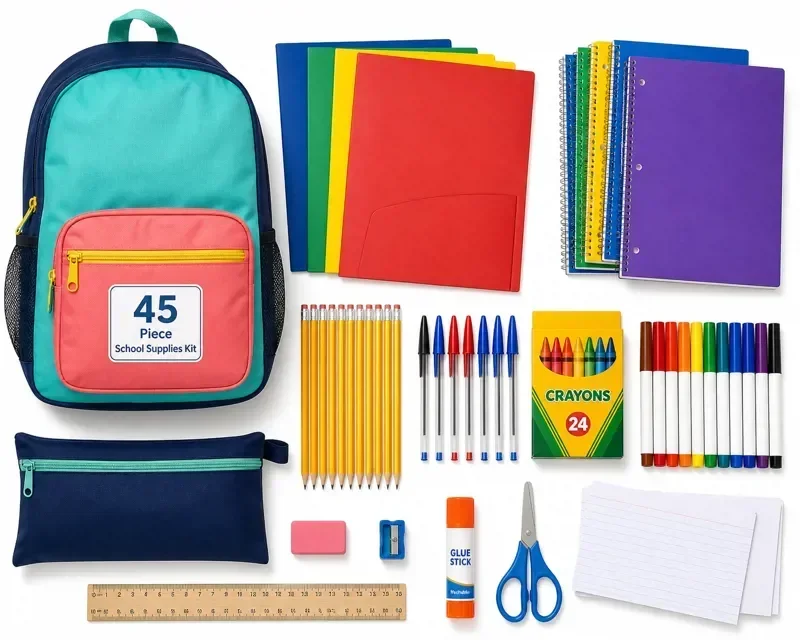
Trail Maker 45-Piece School Supply Kit
Grades K–12 · Includes folders, notebooks, pencils, pens, and more
$18.79 Prime eligible
4.7 out of 5 stars rating
View on Amazon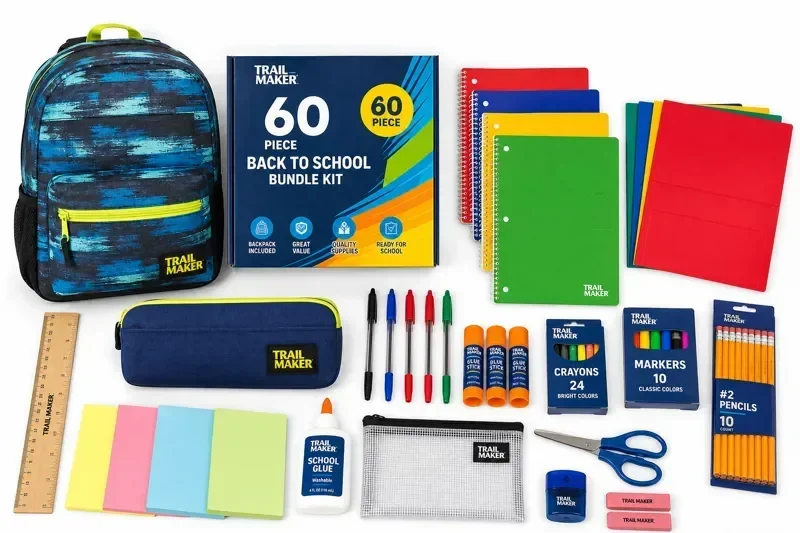
Trail Maker 60-Piece Back to School Bundle
Includes notebooks, folders, composition books, headphones, ruler, and more
$19.71 Prime eligible 10% off
4.5 out of 5 stars rating
View on Amazon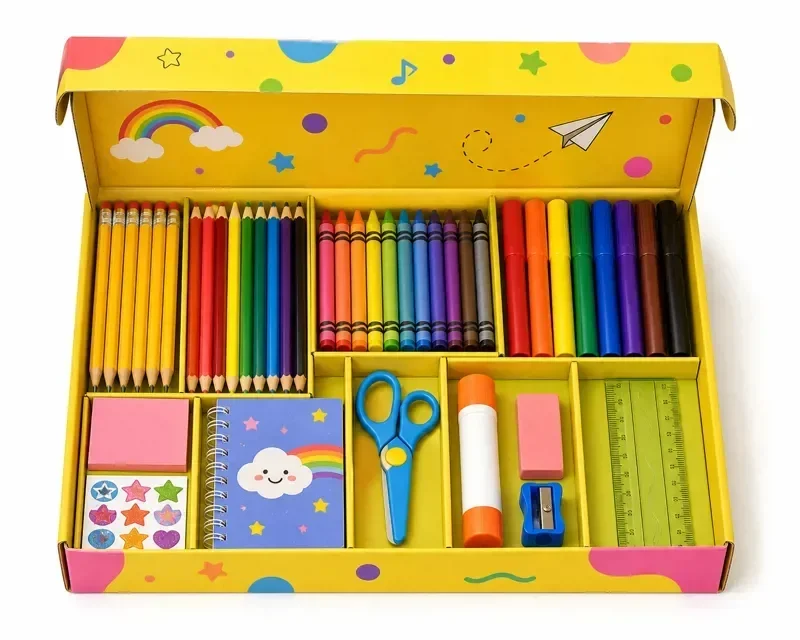
30-Piece School Supply Box Set
Kindergarten through 8th grade · Notebooks, folders, pens, pencils, and more
$11.99 Prime eligible
4.6 out of 5 stars rating
View on AmazonWhat supplies do middle and high school students really need?
Middle and high school students carry significantly more academic weight. They manage multiple teachers, shifting schedules, homework loads that can stretch into the evening, and increasingly sophisticated technology requirements. Organization is no longer optional — it is survival.
What Middle & High School Students Really Need
- Multi-subject binder or subject-specific binders with dividers
- Graphing calculator (TI-84 recommended for algebra and beyond)
- USB flash drive or cloud storage subscription
- Planner or digital calendar app
- Pens (blue, black, red), mechanical pencils, and highlighters
- Index cards for flashcards and test prep
- Sturdy, compartmentalized backpack
- Water bottle and snack-friendly lunch bag
- Portable charger for phone or device
- Noise-canceling earbuds for study sessions
Which backpacks are best for older students?
A quality backpack is one of the most important investments a student can make. Heavy textbooks, laptops, and tablets add up fast — a poorly designed bag leads to back pain and dropped classes. Here are three highly rated options:
SHRRADOO Extra Large Laptop Backpack
Fits 17-inch laptops · Combination lock · Carry-on approved
$29.99 Prime eligible 25% off
4.7 out of 5 stars rating
View on AmazonSHRRADOO Anti-Theft Laptop Backpack
17-inch laptop compartment · Water resistant · Multiple organizer pockets
$19.99 Prime eligible 31% off
4.7 out of 5 stars rating
View on Amazonabshoo Water Resistant Travel Backpack
Lightweight design · Water resistant · Budget-friendly option
$16.00 Prime eligible 47% off
4.6 out of 5 stars rating
View on AmazonWhat tech and dorm essentials does a college student need?
College is a different beast entirely. Students are juggling major-specific equipment, dorm living constraints, and the freedom of adult independence. The essentials shift toward technology, efficiency, and self-reliance.
College Student Must-Haves
- Laptop or tablet (minimum 8 GB RAM, 256 GB SSD)
- External hard drive or cloud storage plan
- Noise-canceling headphones or earbuds
- Portable power bank / USB charger
- Dorm organizer and storage solutions
- Whiteboard or dry-erase board for study sessions
- Multi-plug power strip (dorm rooms rarely have enough outlets)
- Reusable water bottle and insulated lunch bag
- Notebook or tablet for handwritten notes
- Laundry bag, detergent, and basic cleaning supplies
Which laptops are best for college students?
Your laptop is the single most important tool for college. Here are three solid options currently available at various price points:
HP 2026 Pavilion Student Laptop
Intel N100 · 16 GB RAM · 256 GB SSD · Windows 11 with Office 365
$549.98 Prime eligible 35% off
4.4 out of 5 stars rating
View on Amazon15.6" Business Laptop — 16 GB RAM, 512 GB SSD
Core i5 processor · Windows 11 Pro · Office 365 included · 2-year warranty
$379.99 Prime eligible 37% off
4.1 out of 5 stars rating
View on AmazonAuusda 15.6" Business Laptop for Students
16 GB DDR4 RAM · 1 TB NVMe SSD · Backlit keyboard · Fingerprint ID
$294.49 Prime eligible 5% off
4.2 out of 5 stars rating
View on AmazonWhat supplies does each grade level need most?
| Grade Level | Top Priority | Key Supplies | Tech Requirement |
|---|---|---|---|
| Kindergarten | Safety & durability | Crayons, washable markers, safety scissors, pencil grips | None |
| Grades 1–3 | Building routine | Notebooks, pencils, highlighters, pencil case, folders | Computer lab access only |
| Grades 4–5 | Organization across subjects | Binders, dividers, index cards, calculator, sketchbook | Basic computer or Chromebook |
| Middle School | Managing multiple teachers | Multi-subject binders, planner, USB drive, noise-canceling earbuds | Laptop or tablet for assignments |
| High School | Academic depth & independence | Graphing calculator, flashcards, printer ink, portable charger | Full laptop with Office suite |
| College | Self-sufficiency & efficiency | Dorm organizers, power strip, laundry supplies, study board | Laptop/tablet + cloud storage + charger |
How can I save money on back-to-school supplies?
Back-to-school season is one of the biggest retail spending periods of the year. Here are proven strategies for keeping costs down:
- Buy in bulk. Pencil packs, notebook multipacks, and highlighter sets cost significantly less per unit than individual items. The 45-piece Trail Maker kit at $18.79, for example, covers nearly every basic need for a single student.
- Shop off-season. Many retailers discount school supplies in September and October. Stock up then for next year.
- Use price-tracking tools. Browser extensions that track price history help you identify the lowest point before purchasing.
- Repurpose what you can. Undamaged notebooks from last year, partially filled pencil cases, and lightly used backpacks save real money. Only replace what is truly worn out.
- Check store coupons and cash-back apps. Retailers often run back-to-school promotions. Stack coupon codes with cash-back offers for maximum savings.
- Consider dollar stores for basics. Simple items like folders, basic pens, and sticky notes are often available at dollar-store prices with identical quality.
How do I organize supplies so they actually stick?
Having the right supplies is only half the battle. The systems you build around them determine whether a student stays on top of assignments or drowns in overdue work. Here are organization strategies for every age:
For Younger Students (K–5)
- Color-code by subject. Assign each class a color: red for math, blue for language arts, green for science. Color-coded folders and dividers make it impossible to lose assignments.
- Set up a "launch pad." A basket or shelf near the front door where the backpack, lunch box, and permission slips live. Nothing gets forgotten in the morning rush.
- Use a visual chart. A simple checklist chart on the fridge — pack backpack, brush teeth, eat breakfast — builds independence through repetition.
For Middle & High School Students
- Digital calendar is non-negotiable. Google Calendar or Apple Calendar with notifications for assignments, tests, and extracurriculars.
- Weekly review habit. Every Sunday evening, review the week ahead, update the planner, and prep materials. Ten minutes saves hours of stress.
- One notebook per subject. Or one ring binder with tabbed dividers. Loose-leaf paper in a three-ring binder is the fallback, but dedicated notebooks reduce lost-work incidents dramatically.
For College Students
- Digital-first approach. Scan paper handouts immediately. Use apps like Notion, OneNote, or GoodNotes for organized, searchable notes.
- The "Sunday Reset." Same principle as high school but scaled up: clean out your backpack, charge devices, meal-prep if applicable, and review your syllabus calendar for the entire month.
- Cloud backup. Google Drive, Dropbox, or OneDrive — whichever your campus supports. Never store important work solely on your laptop.
What wellness items should be in the back-to-school toolkit?
Supplies and organization matter, but a stressed-out, sleep-deprived student is not a productive one. Include these wellness essentials in your back-to-school prep:
- Sleep schedule adjustment. Start shifting bedtime earlier one week before school starts. A two-hour difference between summer and school bedtimes causes real Monday-morning struggles.
- Healthy snacks. Replace the vending-machine chip habit with nuts, granola bars, fruit, and yogurt. Nutrition directly impacts focus and energy.
- Sunscreen and hats for outdoor transitions. Walking between buildings in late summer heat is no joke — especially for younger kids who tend to forget protection.
- Emotional check-ins. Ask your child or teen how they feel about the upcoming school year. Anxiety about social dynamics, workload, or change is normal and worth addressing early.
What is the final takeaway for back-to-school success?
Back-to-school does not have to mean stress, overspending, or Sunday-night panic. The families and students who thrive are the ones who plan ahead, invest in quality basics, and build systems that reduce daily friction. Whether you are outfitting a kindergartener with their first backpack or equipping a college freshman for independent living, the principles are the same: know what you need, buy smart, and organize with intention.
Use the checklists above as a starting point, pick the product recommendations that fit your budget, and build the routines that work for your family. The first day of school will come whether you are ready or not — and now, you have every reason to be.
Frequently Asked Questions
When should I start buying back-to-school supplies?
Start shopping in July, two to four weeks before school begins. This timing lets you compare prices across retailers, wait for sales events, and avoid the rush. According to Statista, the average U.S. household spends around $875 on back-to-school supplies, so early planning can yield significant savings.
What is the most important back-to-school supply?
The most critical supply depends on the grade level. For kindergarten, it is safety scissors and pencil grips. For elementary, it is color-coded folders and composition notebooks. For middle and high school, it is a reliable graphing calculator and multi-subject binder. For college, it is a dependable laptop and noise-canceling headphones.
How much should I budget for back-to-school shopping?
Families typically spend between $500 and $1,200 per child, depending on grade level and school requirements. The national average is approximately $875 per household. To stay on budget, inventory existing supplies, buy in bulk, and prioritize quality backpacks and electronics that last multiple years.
Do I need to buy everything on the school supply list?
Only what is marked "required." Schools often include "recommended" items that are nice-to-have but not essential. Inventory what you already own from previous years, cross-reference the list, and skip duplicates. This alone can cut your total cost by 30–40 percent.
How can I prevent my child from losing their supplies?
Label everything with a permanent marker or label maker. Use color-coded folders for each subject. Set up a designated "launch pad" near the front door where the backpack lives overnight. And teach your child to pack their bag using a checklist before leaving school each day.



0 comments